
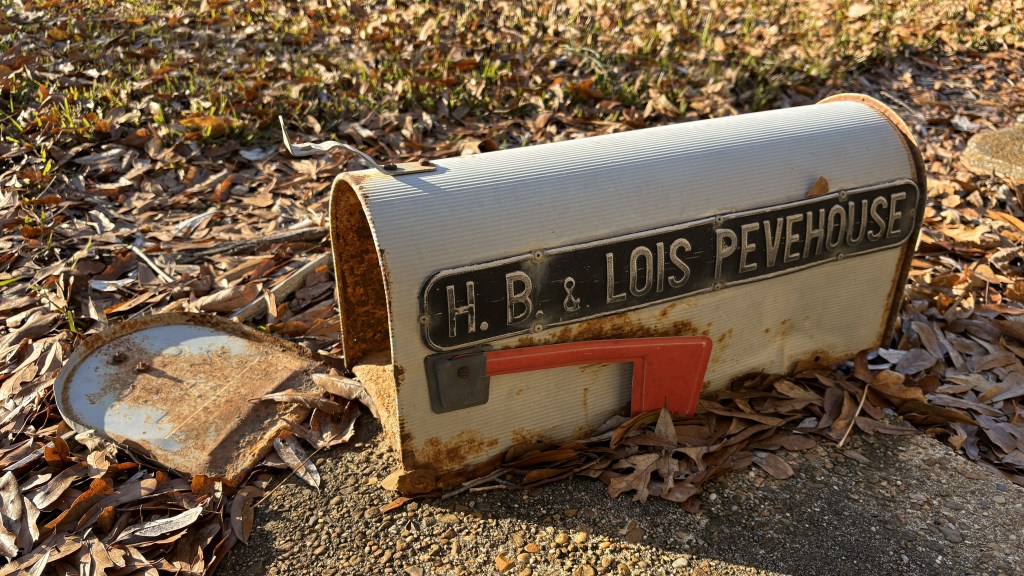
While home for the holidays, I took time to visit my family’s Pevehouse Farms land in northeast Louisiana. I also drove a few miles south of our farm to see for myself the new data center that Meta is building in Richland Parish, and let me tell you, it’s one thing to read that 4 million square feet of farm land is being turned into one of the largest data centers in the world, but it’s another to drive past the mile-long construction site and see it for yourself.
“That project is transformational for this area,” Louisiana’s Governor Landry told local TV news station KNOE (where I interned one summer during college), “but like all good things, it comes with good problems.”
But for those living adjacent to the construction, those “good problems” are daily realities.
It was quiet when I was there – the large trucks, which locals tell me are hauling in dirt from the west and gravel from the east, were on a break for the holidays. But, according to the Louisiana Illuminator news site, thousands of dump trucks and 18-wheelers rumble through there most days. I heard tales of traffic backing up on the Interstate because of them, and the tiny elementary school next door to the construction site has stopped letting children play in their playground because they fear it’s not safe.
“They wrecked into the gate, and then they had to build a whole new gate,” one student told Louisiana Illuminator. “And that’s why they’re saying we shouldn’t go out there… because there’s too many wrecks and Meta trucks. And they could crash.”
There have been 64 crashes in the area between January and mid-September this year, compared to just nine for all of 2024, according to police records obtained by the Gulf States Newsroom. It’s an impact on the area that I hadn’t even thought about.
Since we had to drill a new well on our property last year to have sufficient water for irrigation, the center’s water usage has been more on my mind. The data center will draw from the same Mississippi River alluvial and Cockfield aquifers on which our farmland depends to water crops of soybeans and corn. And we’re not alone in that need. More than 90 percent of withdrawals from the Mississippi River Valley alluvial aquifer in the region currently go to agriculture. It’s already the second-most-pumped aquifer in America, according to a U.S. Geological Survey report.
Recently, Meta predicted the center will use 1.5 million gallons of water a day when operational, which is three times higher than its current most water-intensive data center, according to their 2024 sustainability report. But, they also say they are investing in local “water restoration projects” that will return 100% of the data center’s water consumption to the Boeuf, Tensas, and Lower Mississippi watersheds.
Which sounds nice, but watersheds drain into streams, rivers, and wetlands, and flows away from the area in a few days or weeks. Aquifer recharge happens over years or decades as water slowly soaks through soil and rock layers, meaning surface water restoration doesn’t meaningfully replace what’s being pumped from deep underground to supply drinking water, irrigation, and to cool servers.
The word “transformational” has been used by many corporate executives and Louisiana’s governor when talking about the benefits of this project for an admittedly poor, rural part of my home state. And I’m sure there will be some. The towns of Rayville, Delhi, and Mangham are getting $300,000 from Meta to improve public parks and restore the parish’s “most iconic establishments.”
And last week Meta announced that over the last year they contracted more than $875 million with Louisiana businesses, saying “We’re proud to work with more than 160 Louisiana businesses (84% of which are local to Northeast Louisiana) that support the data center’s construction with electric, paving, utility work and more, as well as dozens of local food vendors who provide daily meals on site.”
And it’s not just Meta creating impact. Entergy Louisiana has broken ground on two natural gas combustion turbine generation facilities to power Meta’s hyperscale campus which might bring a handful more new jobs to the area. And the local community college has received funding from the Louisiana Community and Technical College System to develop programs and expand capacity for its construction trades program.
To date, Meta says they have supported 3,700 construction workers and expect to reach a peak workforce of 5,000 by June 2026. But what happens in 2030 when construction is complete, and those workers head off to the next project? Meta’s Kansas City data center, which recently completed construction, supported roughly 1,500 skilled trade workers, but now expects to employ only about 100 permanent workers.
Once the Richland Parish data center is completed, Meta says it will support more than 500 operational jobs, including electricians, HVAC specialists, server and network technicians, safety and security experts, and engineers.
Maybe I shouldn’t look a gift horse in the mouth, and any economic injection into the region that built me should be appreciated. I sincerely hope Meta’s water restoration proves more effective than I expect, and that the economic benefits extend beyond construction. I just can’t shake this feeling, however, that the transformation will not be as wonderful as the hype.
I guess I’ll just have to keep watching to see how good the “good problems” really turn out to be. In the meantime, I’d love to hear from anyone who has seen similar developments transform their community. What made the difference between hype and genuine benefit?
###
 Everything Else